
REVIEW · EPHESUS AND THE HOUSE OF THE VIRGIN MARY
Ephesus Small Group Day Tour from Selcuk
Ephesus is big, so pacing matters. This full-day small-group tour from Selcuk helps you hit the big names and the context, with a guide in English and a comfortable air-conditioned minivan. You will see where faith, politics, and trade mixed over centuries, then finish the day back in Selcuk.
What I like most is the convenience: you get hotel pickup and drop-off, and the ride keeps you from wasting hours on logistics. I also like that the day is built around major Ephesus monuments, with admission included for each stop, plus lunch.
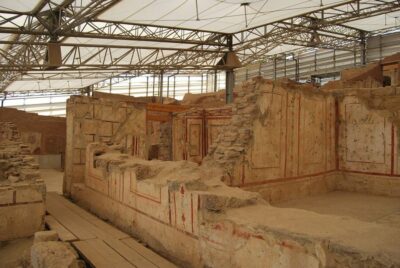
One thing to consider is that the schedule can include time at shopping stops, not just archaeology. If you want a pure ruins-only day, you may need to mentally budget for that, especially if you have add-on interests like the Terrace Houses.
In This Review
- 5 key things that make this Ephesus tour worth your time
- Why a small-group Ephesus tour from Selcuk works better than DIY
- Morning logistics: pickup times, minivan comfort, and keeping your day on track
- House of the Virgin Mary: a pilgrimage stop with strong personal meaning
- Ephesus Ancient City: the heart of the day and your best “one-and-done” payoff
- Odeion: the small theater that hints at politics and daily life
- Temple of Hadrian: Curetes Street and the Roman layer you do not want to miss
- The Library of Celsus: the photo stop with real architectural tricks
- Great Theater: scale that still hits, even with the roof missing
- Temple of Artemis: what’s left, and why one pillar can tell the whole story
- Isa Bey Mosque: finishing the day in Selcuk with Seljuk-era architecture
- Price and value: what about $150.18 really covers
- The one concern: shopping stops and how they can affect your day
- Guide quality: the story is what makes the stones click
- Who this tour is best for
- Should you book this Ephesus tour from Selcuk?
- FAQ
- How long is the Ephesus Small Group Day Tour from Selcuk?
- Where does hotel pickup happen?
- What time does the tour start?
- What language is the tour offered in?
- How many people are in the group?
- Is lunch included?
- Are admission tickets included?
- What sites are included in the day?
- Do I need to download anything to use the tickets?
- What is the cancellation policy?
5 key things that make this Ephesus tour worth your time
- Small group size (max 15) means you can ask questions without yelling over a crowd.
- Hotel pickup from Selcuk keeps the morning simple, with pickup times set shortly before the tour day.
- Admissions included for the main sights, so you do not have to micromanage ticket lines.
- A balanced route: Mary’s House, Ephesus highlights, Roman monuments, Artemis, then a Selcuk mosque finish.
- Guide quality can swing, so if you care about storytelling, choose a day when you are likely to get a strong guide (Begum was specifically praised by name).
Other Ephesus visits, with and without the House of Mary
- From Izmir: Full-Day Ephesus Tour with Lunch★ 4.7 · 642 reviews
- Daily Ephesus and Virgin Mary House Tour with Lunch Included★ 5.0 · 334 reviews
- Full-day Pamukkale and Hierapolis Tour from Selcuk or Kusadasi★ 5.0 · 209 reviews
- From Izmir: Guided Tour of the Ancient City of Ephesus★ 4.7 · 205 reviews
Why a small-group Ephesus tour from Selcuk works better than DIY
Ephesus is not a “walk around and figure it out” kind of place. You are looking at ruins that span different eras, and the site is large enough that random wandering can leave you missing the main beats. This kind of small-group day tour helps you connect the dots fast, with a guide who can point out what you are looking at and what it meant to the people who built it.
From Selcuk, it also makes practical sense. You start close to the archaeological area, you move by minivan in comfort, and you get back to your hotel at the end of the day. That last part matters if you have only a short time on the coast.
Morning logistics: pickup times, minivan comfort, and keeping your day on track
This tour runs about 8 hours and starts around 9:00 am. If you are staying in Selcuk, pickup is usually between 9:00 am and 9:30 am, with the final time decided a day before based on your exact pickup point and how many additional stops are on the route.
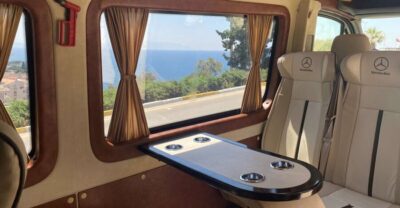
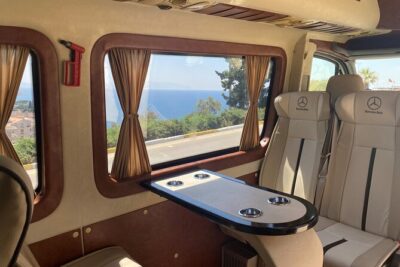
The trip to Ephesus is made in an air-conditioned minivan, which is a big deal in warmer months. It also protects your energy. By the time you reach the ruins, you can start looking instead of burning your morning on transport.
If you are coming from Kusadasi, pickup is typically earlier, from about 8:00 am to 9:00 am, so plan your morning around a prompt start.
House of the Virgin Mary: a pilgrimage stop with strong personal meaning
The first stop is the House of the Virgin Mary (Meryem Ana Evi). You get about 30 minutes, and admission is included. This is one of those places where the “what” matters, but the “why” matters even more.
The beliefs tied to the house say Mary, the mother of Jesus, spent her final years in Ephesus. Many people link this period to 37 to 45 CE, and different Christian traditions describe her later fate in their own terms, Catholic doctrine using Assumption and Orthodox belief using Dormition.
Why it is a good opener for the day: it sets the emotional tone before you hit the Roman and classical monuments. Also, it is a short stop that does not steal your whole morning.
Practical tip: this is a pilgrimage site, so dress modestly and keep your voice down. You are there to observe, not sprint.
Ephesus Ancient City: the heart of the day and your best “one-and-done” payoff
Next comes Ephesus Ancient City, with about 2 hours and admission included. Ephesus is often considered the grandest and best-preserved of Turkey’s Mediterranean ancient cities, and the reason you feel it right away is scale plus layout. Streets, theater, monuments, and the overall urban design give you a sense of how people moved and lived.
You will also learn the religious and economic angle. Ephesus was a major trading city, and it was a center for the cult of Cybele, an Anatolian fertility goddess. That blend of commerce and belief is what makes Ephesus more than just “old stones.”
A note on timing: 2 hours is enough to see the main elements without rushing to exhaustion, but it is not enough for a full, slow museum-quality exploration. If you want extra sites or deep independent wandering, you may feel you are trading time for coverage.
- Shore Excursions: 3 Hours Easy Ephesus Tour
★ 4.5 · 136 reviews - Ephesus Day Trip from Istanbul incl Domestic Flights
★ 5.0 · 128 reviews - Kusadasi Shore Excursion : Ephesus Private Tour ONLY FOR CRUISE GUESTS
★ 5.0 · 101 reviews - Ephesus Shore Excursion: Private Guide and Vehicle
★ 4.5 · 98 reviews - From Istanbul: Day Trip to Ephesus with Flight and Lunch
★ 4.7 · 66 reviews
Odeion: the small theater that hints at politics and daily life
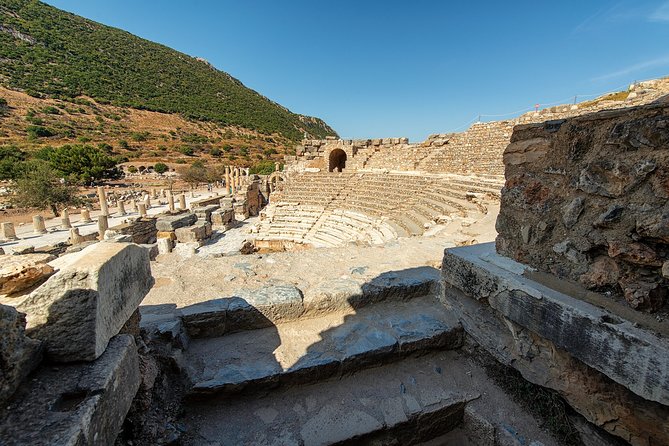
After the broad city overview, you stop at the Odeion for about 15 minutes, admission included. This is a smaller, semi-circular theater built in the 2nd century A.D. and financed by Publius Vedius Antonius and his wife Flavia Paiana.
Here is what I find useful about including it: it expands the story beyond emperors and famous temples. The Odeion was used for political meetings, social events, concerts, and performances. In other words, it shows how civic life and entertainment overlapped.
If you like architecture details, this is a nice “breather” stop. You can shift from the bigger spaces into a more human scale.
Temple of Hadrian: Curetes Street and the Roman layer you do not want to miss
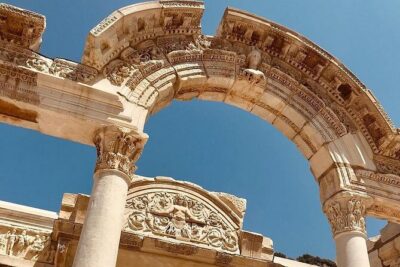
Then you head to the Temple of Hadrian, around 15 minutes, admission included. This temple is tied to Emperor Hadrian, constructed in the beginning of the 2nd century AD to celebrate his visit from Athens.
A practical reason to enjoy this stop: it helps you read Ephesus as a layered city. Even if your brain starts out thinking Greek and classical, Roman construction and dedications change how the city functions and how it represents power.
The Library of Celsus: the photo stop with real architectural tricks
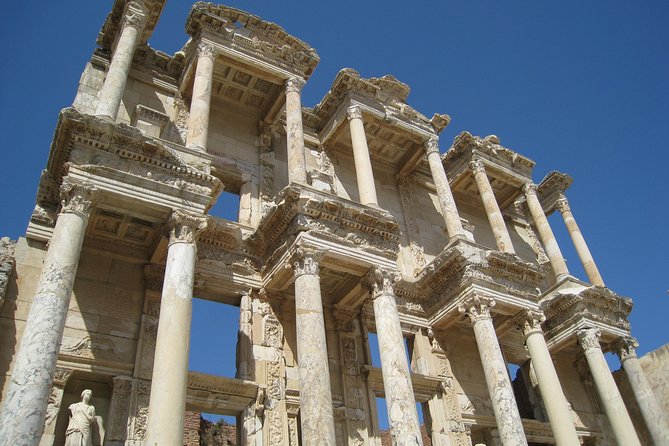
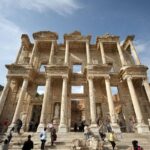
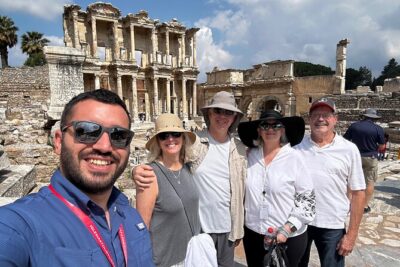
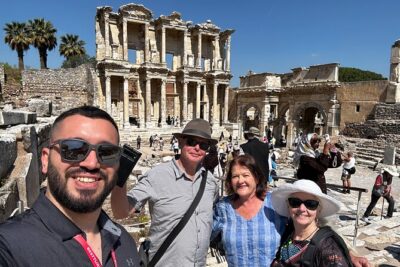
Next is the Library of Celsus (Bibliothèque de Celsus), about 20 minutes, admission included. This is one of the best-known monuments in Ephesus and dates to the early 2nd century AD. It has been extensively restored, which helps you see its original intent rather than just outline fragments.
What makes it more interesting than a pretty façade is the design trick. The library’s structure uses visual effects: the convex façade base makes central elements look taller, and the middle columns and capitals are built larger than those at the ends. Even if you never took a single art class, your eyes catch the intention.
The niches on the façade once held statues of four virtues, typically identified as Sophia (Wisdom), Arete (Goodness), Ennoia (Thought), and Episteme (Knowledge). That symbolism connects architecture to education and public identity.
If you want a tip that saves time: take your main photos early in the stop. The library looks good from multiple angles, and you will want to spend more time looking once you have your images.
Great Theater: scale that still hits, even with the roof missing
You then visit the Great Theater for about 20 minutes, admission included. This one is marble, and it is huge. The theater measures roughly 145 meters wide, with an audience space that reached about 30 meters in height at its height. It could hold up to 24,000 spectators.
The construction began in Hellenistic times, and that matters. It links this site to older traditions while showing how later rulers kept using mass gatherings for culture and civic expression.
The drawback to know: at some points you are likely standing on uneven ground and moving between viewing areas. Bring comfortable shoes and expect to do real walking even though the stop time is only 20 minutes.
Temple of Artemis: what’s left, and why one pillar can tell the whole story
After the theater, you go to the Temple of Artemis, about 15 minutes, admission included. This is one of the Seven Wonders of the Ancient World. Today, it is mostly remembered through a reconstructed solitary pillar, located in an empty field to the west of the city center.
At its peak, the temple is said to have counted 127 columns. It also faced damage from earthquakes, Goths, and plain old time. So you do not visit a full temple complex. You visit the idea of it, in physical form.
Why this stop is still worth it: it helps you understand how ruins work. Even when the structure is mostly gone, the site anchors memory and meaning. It is a quick stop that can turn into a strong mental picture.
Isa Bey Mosque: finishing the day in Selcuk with Seljuk-era architecture
To end, you visit Isa Bey Mosque for about 15 minutes, admission included. This mosque was built in a post-Seljuk to pre-Ottoman transitional style, during Selcuk’s time as capital of the Aydin Emirate.
The Arabic inscription over the entrance states the build date as 1375, so you are jumping from classical and Roman eras into medieval Turkish architecture. The mosque is known for its brick minarets and Iznik-tiled domes, plus its 12 columns inside.
Why it is a good closer: it shifts your brain away from archaeology into architecture you can still sense as functional and lived in. It also gives your day a Selcuk identity rather than feeling like a drive-through.
Price and value: what about $150.18 really covers
At around $150.18 per person for about 8 hours, this is not a budget gamble. It is priced like a day that includes the hard-to-organize pieces: professional guide, air-conditioned transport, hotel pickup and drop-off, lunch, and admission tickets for the included stops.
If you try to piece together your own day from Selcuk, you typically end up paying for transportation, then paying entry fees one by one, then trying to figure out where your time goes. Here, you trade flexibility for structure. For most people, that is a fair deal.
The best value comes when:
- you want interpretation, not just sightseeing
- you are happy to follow the route without spending your own hours planning
- you prefer a small group over a large bus crowd
The one concern: shopping stops and how they can affect your day
A key balance to strike is time in the ruins versus time on commercial stops. One experience that came up clearly involved long stops at places like a carpet weaving stop and a leather goods store, even including a fashion-show style presentation in one case. Another issue was that lunch was served in a shop setting, not at what you might call a normal local lunch spot.
I do not think this makes the tour “bad.” It just means your day may feel less archaeology-focused than the ideal in your head. If you want a strict ruins-first plan, go in expecting that the schedule may include some shopping-style interruptions.
How you protect your time:
- Decide before you go whether you will browse or skip. Your brain works better when it is not negotiating in the moment.
- If there is an add-on you care about, like the Terrace Houses, plan ahead for extra ticket needs and whether the day gives enough time.
Guide quality: the story is what makes the stones click
The guide is the difference between seeing ruins and understanding them. In positive feedback, one guide name that was praised was Begum, described as a standout, with clear explanations and time taken to make things understandable.
Other feedback also points out that a guide’s narrative style can vary. In one less satisfying experience, the pacing felt pushed toward sensational stories that did not always connect to the sights. That is a reminder that even with a fixed itinerary, the day can feel different depending on who you get.
My advice: if you care about deep interpretation, bring curiosity. Ask questions at stops, and do not be afraid to steer the conversation back to what you are looking at right then.
Who this tour is best for
This is a strong fit if:
- you want a guided Ephesus day without wrestling transport and tickets
- you like structured sightseeing with enough time to actually look
- you value a small group and a guide you can ask questions of
It may be less ideal if:
- you want a strictly ruins-only itinerary with no shopping interruptions
- you want extra sites that are not built into the schedule and you dislike time pressure
Should you book this Ephesus tour from Selcuk?
Book it if you want a smooth, guided day that covers the essentials, with admissions and lunch included and pickup taken care of. The route hits the classics you should not miss, and it adds useful context through stops like the Odeion and Temple of Hadrian.
Consider passing or switching plans if shopping stops and store lunch would annoy you. In that case, look for an option that keeps the day focused tightly on archaeological sites, or plan a self-guided afternoon where you can linger without the schedule tugging you along.
In short: if you like structure and stories, this tour is a good way to get your bearings fast. If you only want ruins and nothing else, go in with clear expectations about how the day is organized.
FAQ
How long is the Ephesus Small Group Day Tour from Selcuk?
It runs about 8 hours.
Where does hotel pickup happen?
Hotel pickup is offered. If you are in Selcuk, pickup is usually between 9:00 am and 9:30 am. If you are in Kusadasi, pickup is usually between 8:00 am and 9:00 am, or 8:00 am to 09:00 am. The final pickup time is set 1 day before.
What time does the tour start?
The start time is listed as 9:00 am.
What language is the tour offered in?
The tour is offered in English.
How many people are in the group?
The tour has a maximum of 15 travelers.
Is lunch included?
Yes, lunch is included. Drinks are not included, including alcoholic drinks which you can purchase.
Are admission tickets included?
Admission tickets are included for the stops listed on the itinerary.
What sites are included in the day?
The included stops are the House of the Virgin Mary, Ephesus Ancient City, Odeion, Temple of Hadrian, Library of Celsus, the Great Theater, Temple of Artemis, and Isa Bey Mosque.
Do I need to download anything to use the tickets?
The tour uses a mobile ticket.
What is the cancellation policy?
Free cancellation is available. You can cancel up to 24 hours in advance for a full refund. If you cancel less than 24 hours before the experience starts, the amount paid is not refunded.
Ephesus, Other Ways to See It


Recently reviewed in Selcuk

The rest of Ephesus and the House of the Virgin Mary.
 ★ 5.0FOR CRUISERS: Skip The Lines PRIVATE EPHESUS TOUR &On Time ReturnFrom $398,527 reviews
 ★ 5.0PRIVATE NO HIDDEN FEES Ephesus, Mary’s House Guided Tour /GRP OPTFrom $992,455 reviews
 ★ 5.0For Ship Guests:BEST SELLER EPHESUS PRIVATE TOUR & On Time ReturnFrom $392,029 reviews
 ★ 5.0ALL INCLUDED: Ephesus Ruins, Mary’s House Tour incl ENTRY TICKETSFrom $591,670 reviews
 ★ 5.0Ephesus Temple of Artemis and House of Mary Private Half Day TourFrom $151,573 reviews
 ★ 5.0PRIVATE TOUR FOR CRUISERS: Mary’s House (Meryemana) and EphesusFrom $291,349 reviews
 ★ 5.0Top-Rated: Ephesus & Artemis Tour for Cruisers WITH ENTRY TICKETSFrom $201,184 reviews
 ★ 4.8Ephesus: Small Group Tour for Cruise PassengersFrom $291,100 reviews