
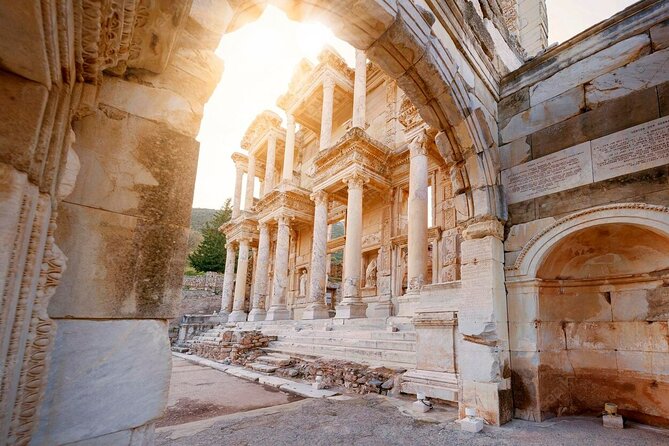
REVIEW · EPHESUS AND THE HOUSE OF THE VIRGIN MARY
NEW: Private The Most Detailed Ephesus Shore Excursion / with Lunch
Ephesus feels smaller when you have a plan. This private shore excursion strings together the big names plus the extra context most groups skip, from Meryemana (Virgin Mary’s House) to the Great Theatre, with a real Turkish lunch in the middle. I like the way the tour is built around your pace, not the other way around, and I also like that transport is handled by an air-conditioned Mercedes van instead of a stressful pile of taxis. One thing to watch: the headline ticket price does not include most site admission fees, so your day budget should include entrance costs.
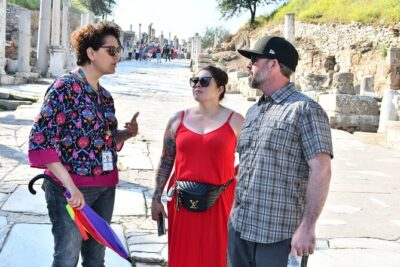
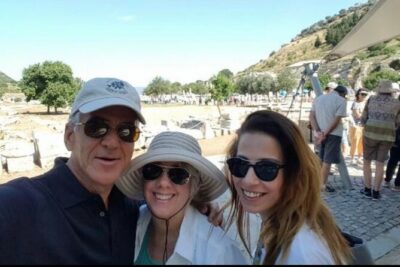
What makes this one worth your attention is the practical structure. You get pickup and drop-off, an English-speaking licensed guide, parking fees handled, and a promised skip-the-long-lines advantage. In the real world, the “private” part matters too, because guides like Selin, Nesli, Mehmet, Ahmet, Tas, Asli, Özgür (Oscar), and Mary were repeatedly praised for tailoring the route and pacing to the group.
In This Review
- Key Things That Make This Ephesus Tour Worth Considering
- Price and Value, Plus the Entry Fees You Should Expect
- Timing and Transport From Kusadasi, Including Cruise Day Reality
- Meryemana (Virgin Mary’s House): Calm, Sacred, and Not Just a Photo Stop
- Ancient City of Ephesus: The Main Route, With Stops That Change How You See It
- State Agora and the Odeion: Where Politics, Meetings, and Sound Used to Live
- State Agora
- The Odeion
- Domitian Temple, Hercules Gate, and Hadrian Temple on Curetes Street
- Temple of Domitian
- Hercules Gate
- Temple of Hadrian
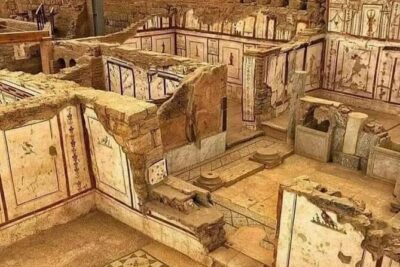
- Ephesus Terrace Houses: The Stairs Are Worth It
- Library of Celsus and the Great Theatre: Two Stops That Make the City Feel Big
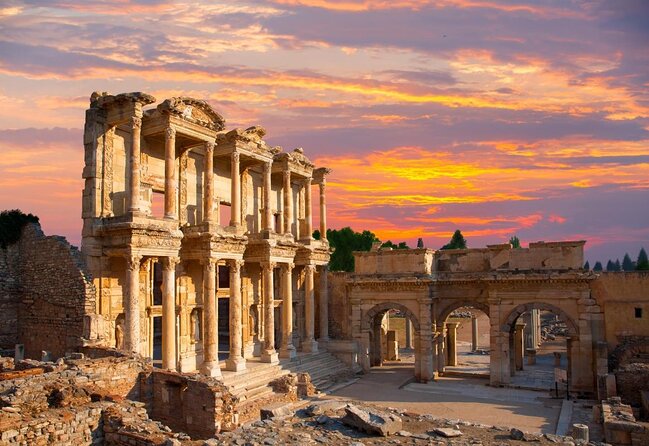
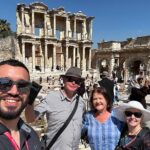
- Library of Celsus
- Ephesus Ancient Greek Theatre
- Temple of Artemis Foundations and St. John Basilica: Two Different Kinds of Meaning
- Temple of Artemis
- Basilica of St. John
- Lunch at a Turkish Local Restaurant: Simple, Filling, and Timed for a Long Walk
- Shopping Stops and the Rug Workshop Pressure Question
- Who Should Book This Private Ephesus Tour?
- Practical Tips So Your Ephesus Day Stays Fun
- Should You Book This Private Ephesus Shore Excursion?
- FAQ
- What does the tour price include?
- Are admission tickets to Ephesus Ancient City included?
- Is lunch included, and are drinks included too?
- Which other site admissions are not included?
- Do I get pickup if I am a cruise passenger?
- Do I get pickup if I’m staying at a hotel?
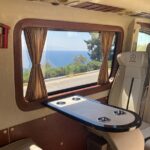
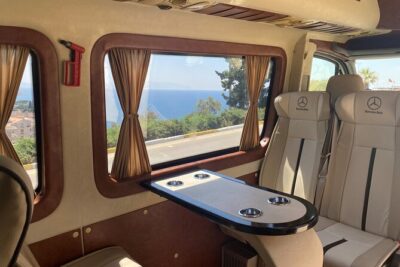
- What vehicle is used for transport?
- Is the tour private?
- Is the tour offered in English?
- What if I need to cancel?
Key Things That Make This Ephesus Tour Worth Considering
- Skip-the-line service is built into the experience, not left to chance
- Private, custom pacing means you can linger at the stops you care about
- Lunch is included at a local Turkish restaurant, with drinks not included
- A focused ancient route hits both major monuments and smaller, explainable corners of the city
- Licensed English guide with pickup and drop-off from cruise, hotel, or airport
Other Ephesus visits, with and without the House of Mary
- FOR CRUISERS: Skip The Lines PRIVATE EPHESUS TOUR &On Time Return★ 5.0 · 8,527 reviews
- Top Choice For Cruisers: Ephesus, Mary’s House WITH TICKETS+LUNCH★ 5.0 · 7,233 reviews
- PRIVATE EPHESUS TOUR FOR CRUISERS: On-time Return and Skip-Line★ 5.0 · 5,807 reviews
- PRIVATE NO HIDDEN FEES Ephesus, Mary’s House Guided Tour /GRP OPT★ 5.0 · 2,455 reviews
Price and Value, Plus the Entry Fees You Should Expect
The tour price is $79.20 per person for a 5 to 7 hour private excursion. That amount covers the guide, pickup and drop-off, transportation in an air-conditioned Mercedes van, parking, and lunch. For cruise days, I think this is the real value, because it reduces the risk of time slip while you are juggling ships schedules and a site that runs on a lot of walking.
The part you should budget for separately is admissions. The tour does not include:
- Ephesus Ancient City: €40 per person
- Virgin Mary House (Meryemana): €18 per person
- Ephesus Terrace Houses: €15 per person
- Basilica of St. John: €6 per person
Those four items add up to €79 in total entry fees per person, before any drinks with lunch. The Great Theatre entry is listed as included, which helps, but the main Ephesus city admission is still a separate cost. If you like the idea of getting more than the usual “hit the highlights” route, it still tends to be worth it. You just want to go in knowing you are paying a combined total: tour price plus the site fees.
Timing and Transport From Kusadasi, Including Cruise Day Reality
This is built for real schedules. You are picked up and dropped off, and your transport is a Mercedes van with air-conditioning. That matters in Turkey in warm months, when even the shade breaks your concentration and makes you rush.
For cruise passengers, the meeting point is specific: you meet guests at the exit gate of the immigration terminal of the cruise port with a board that says OTTI Travel. You also provide your ship name, docking time, disembarkation time, and re-boarding time at booking. That last detail is important, because an Ephesus day can expand or shrink depending on crowd levels and your group pace.
If you are coming from a hotel, the meeting is at the hotel reception. If you are doing airport pickup, you meet at the exit gate of the domestic terminal with an OTTI Travel sign.
Meryemana (Virgin Mary’s House): Calm, Sacred, and Not Just a Photo Stop
Most Ephesus days begin with temples and theaters, so starting at Meryemana can feel like a reset button. The House of Virgin Mary is a different mood. You get around 30 minutes here, with admission ticket not included.
What I like about this stop is that it gives you context beyond the Roman Empire. Even if you are not chasing religious sites, it helps you understand why people have traveled here for centuries. Also, it is one of the moments in the day when you can slow down, take a breath, and then step back into the ancient city with your brain switched on.
The only real drawback is the extra admission you pay separately. But if you want the fuller Ephesus story, it is part of the package.
Ancient City of Ephesus: The Main Route, With Stops That Change How You See It
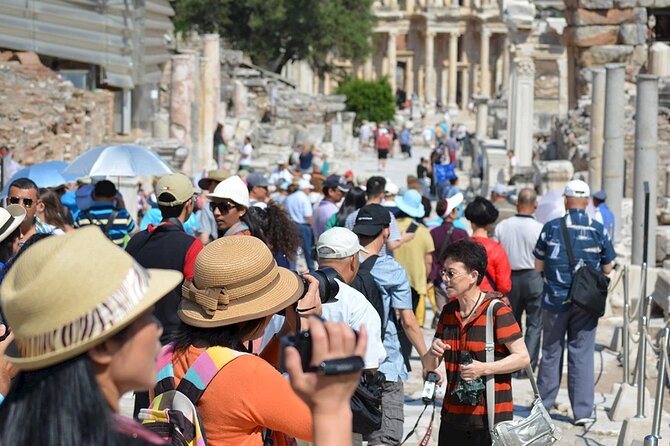
The ancient city segment is where your guide earns their pay. You get about 2 hours around a set of major areas and connecting streets, including Harbor Street, the theatre area, the Marble Street, and the long sweep of sites around the Library district and major temples.
This route is not just a checklist. It is a way of understanding how a city worked. For example, you pass ceremonial and civic areas, then you see how the city’s commercial and public spaces connect. You also have a chance to notice how visitors move through Ephesus today versus how people moved through it in Roman and pre-Roman times.
A few specific highlights you should look for as you walk:
- The Celcius Library area is one of the easiest places to get your bearings fast, because it feels like a monument with a purpose, not just scattered stone
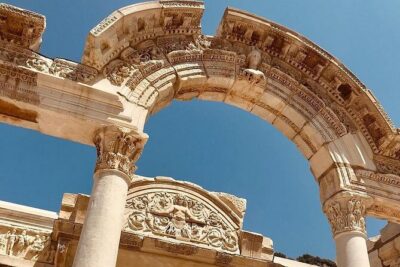
- The Hadrian Temple on Curetes Street is built to impress from the street line, so if you pause for a moment and look straight on, it will click
- The “in between” structures like baths, fountains, and gates help you see that Ephesus was a lived-in city, not only a museum
The practical catch: Ephesus Ancient City entry is not included, so you will want to keep an eye on the fees and have a simple plan for getting everyone admitted and moving promptly.
Other port day plans that get you back on time
- For Ship Guests:BEST SELLER EPHESUS PRIVATE TOUR & On Time Return
★ 5.0 · 2,029 reviews - PRIVATE TOUR FOR CRUISERS: Mary’s House (Meryemana) and Ephesus
★ 5.0 · 1,349 reviews - Top-Rated: Ephesus & Artemis Tour for Cruisers WITH ENTRY TICKETS
★ 5.0 · 1,184 reviews - Ephesus: Small Group Tour for Cruise Passengers
★ 4.8 · 1,100 reviews - Ephesus and Temple of Artemis Private Tour from Kusadasi Port
★ 5.0 · 672 reviews
State Agora and the Odeion: Where Politics, Meetings, and Sound Used to Live
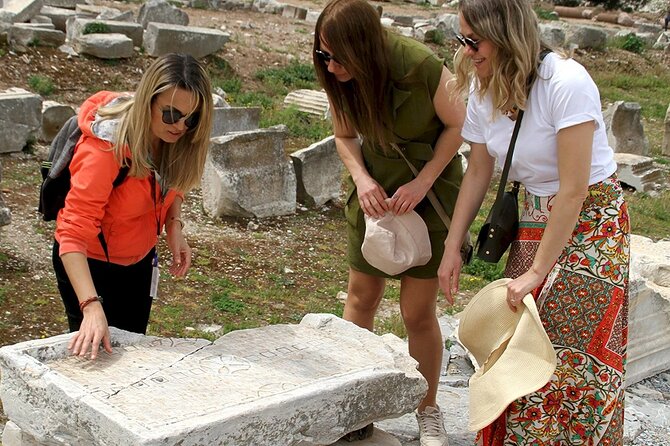
Two stops that help the city feel real are the State Agora and the Odeion.
State Agora
This agora is described as a place used not for commerce but for governmental business, with meeting discussions taking place there. You also get a quick explanation of archaeological findings, including graves from earlier periods and a stone-paved road, plus an archaic sarcophagus of terra cotta. There is also a water reservoir corner connection, linked to the Pollio Aqueduct.
You only spend about 15 minutes here, so treat it as a “spotlight stop.” Look for the layout and imagine what it would mean to gather there regularly.
The Odeion
The Odeion is a small-theatre shape building with a double function. It served as a Bouleuterion for senate or boules meetings, then as an odeum concert hall. It could hold about 1500 spectators, with stage doors and a narrow podium.
The useful way to visit this stop is to stand where you can picture seating. Think: meeting first, then performance. That mental switch makes Ephesus feel like a functioning civic machine instead of a pile of ruins.
Admission tickets are also not included for these segments, as listed, but the time is short and the explanations give them weight.
Domitian Temple, Hercules Gate, and Hadrian Temple on Curetes Street
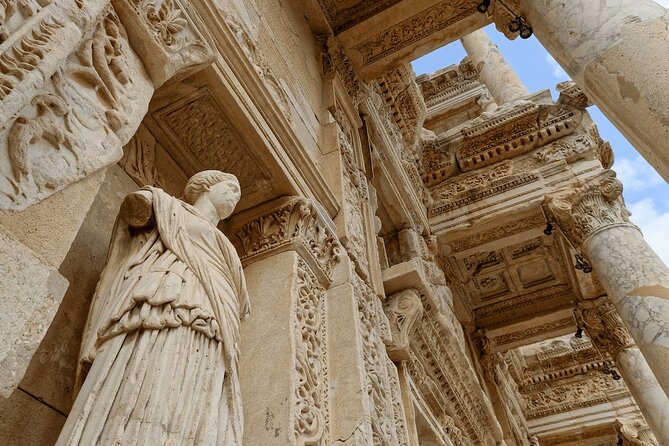
These three stops sit along the “showy” portion of the route, so they are ideal if you want architecture you can read with your eyes.
Temple of Domitian
Built on a high terrace with vaulted foundations, the Domitian Temple is the first structure at Ephesus known to be dedicated to an emperor. The pro-style plan, column counts, and altar details give you a clear sense of how Roman authority was staged publicly.
You spend about 15 minutes. The benefit is that it is a quick architectural lesson, and you end the stop with a better sense of what “imperial cult” looked like in stone.
Hercules Gate
This is reached toward the end of Curetes Street. It is called the Hercules Gate because of a Hercules relief. Only parts of the columns remain today, but you still get a sense of how street access narrowed to keep vehicles out, hinting at how the city shifted toward pedestrian flow in later centuries.
Again, this is about 15 minutes, but it is a strong stop for understanding street dynamics. Gates were not only decorative. They controlled movement and reinforced street identity.
Temple of Hadrian
This is one of the best-preserved and most striking structures on Curetes Street. It has Corinthian columns supporting a curved arch, with a central relief associated with Tyche. There are also inscriptions linked to later statue bases.
You get about 10 minutes, and you should use that time to look up and outward. The facade is meant to be seen from street level.
All three are short stops, and that’s intentional. Your guide keeps the day moving so you can reach the bigger set pieces without rushing through everything.
Ephesus Terrace Houses: The Stairs Are Worth It
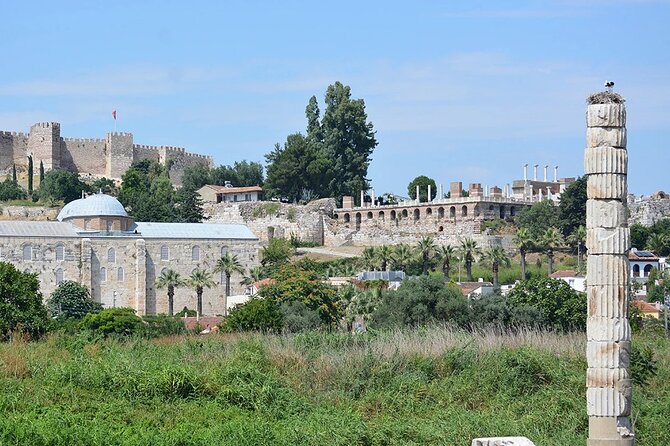
Then comes a stop that often decides whether someone loves the day or just likes it.
The Ephesus Terrace Houses are on a hill opposite Hadrian Temple. They were homes of wealthy Romans, built with terraces and a Hippodamian street layout logic. You get about 30 minutes here, and admission ticket is not included.
Here is why I think Terrace Houses deserve a place on your list:
- You see mosaics and frescos preserved under protective roofing
- You get a glimpse of family and domestic life, not only civic crowds
- You get a physical reminder that Ephesus was built on slopes and levels, so homes were engineered like a statement
The drawback is straightforward: you will likely deal with stairs. Even if you are generally mobile, plan for steps and uneven surfaces. The tour suggests a moderate physical fitness level, which matches the reality of being on-site for a full Ephesus day.
Library of Celsus and the Great Theatre: Two Stops That Make the City Feel Big
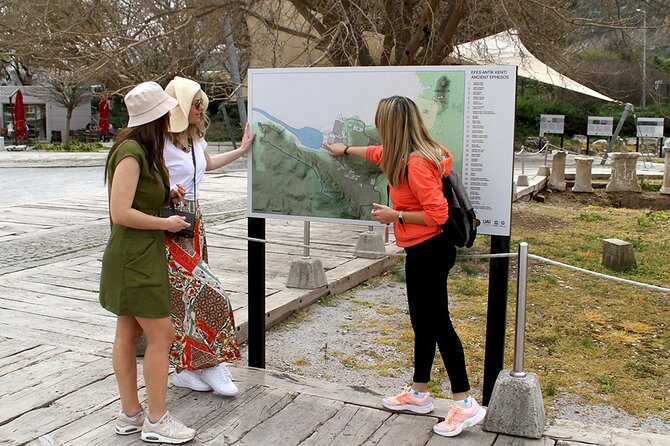
If you only had time for two places, these are usually the ones that land hardest.
Library of Celsus
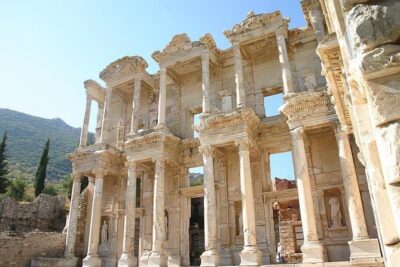
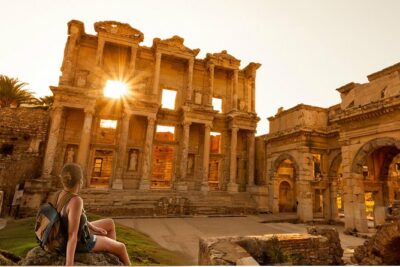
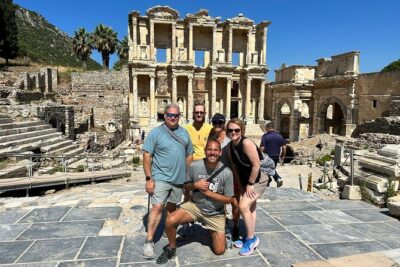
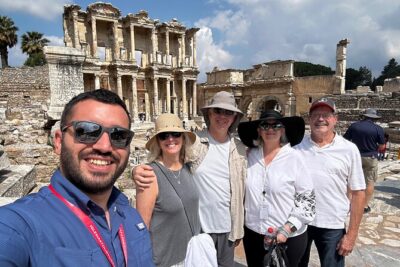
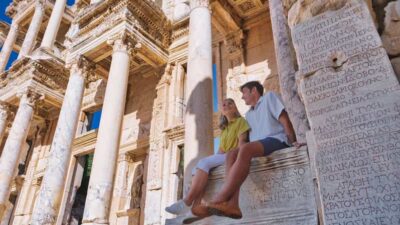
You spend about 30 minutes at the Library of Celsus, built in 117 A.D. It was a monumental tomb for Gaius Julius Celsus Polemaeanus, with the burial beneath the ground floor and a statue of Athena associated with wisdom. The structure also links to how scrolls were stored in wall niches, protected by double walls from temperature and humidity.
What I love here is how the building still reads as both memorial and civic institution. It is not abstract. It has a front, a purpose, and a way it frames visitors walking toward it.
Ephesus Ancient Greek Theatre
Then you hit the main show. The Great Theatre was first built in the Hellenistic period, then enlarged in Roman times into its current style. It holds about 25,000 seats and is described as the largest in Anatolia. You also get context for how it served political, religious, and philosophical discussions, plus performances and even gladiator and animal fights.
You get about 25 minutes, with theatre admission included. Use this time to take in the scale, then look for seating divisions. When you can visualize how a crowd would fill the rows, the place stops feeling like ruins and starts feeling like a venue.
Temple of Artemis Foundations and St. John Basilica: Two Different Kinds of Meaning
After the theatre, your route turns toward two places that represent different layers of belief.
Temple of Artemis
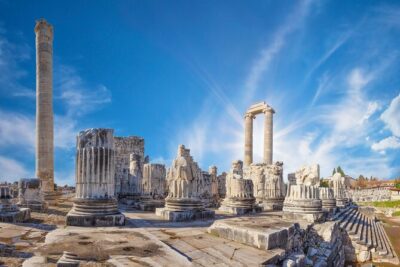
You spend about 40 minutes at the Temple of Artemis site. Today you mainly see the foundations, because centuries turned the area into a swamp. What remains is marble foundation work and the idea of columns and sculptured capitals that once belonged to a major wonder.
You also learn that beautiful remains are today exhibited in the British Museum. That helps you connect what you see in Ephesus with what you might have seen in museum galleries far away.
Basilica of St. John
Next is the Basilica of St. John, about 40 minutes. It is linked to Christian tradition, with St. John believed to have spent his final years nearby and been buried on the southern slope of Ayosoluk Hill. A chapel formed over the grave, then later became a basilica under Emperor Justinian-era changes.
Even if your interest is mostly classical archaeology, this stop gives you a sense of continuity. Ephesus stayed important enough to build new sacred structures long after the ancient city era.
Lunch at a Turkish Local Restaurant: Simple, Filling, and Timed for a Long Walk
Lunch is included, and this is one of the most practical parts of the day. You are out for 5 to 7 hours, and Ephesus walking adds up fast. The lunch being included means you can focus on the sites instead of hunting for food under time pressure.
Drinks are not included, so if you drink more than water, plan ahead. In practice, you might find the lunch is plentiful and includes local touches like pomegranate juice or fig samples, but you should still treat your own meal as the main plan and not count on extras.
A smart move: pace yourself with lunch so you do not feel heavy during the last museum-style stops. This is a day of stone and sun. Easy food is your friend.
Shopping Stops and the Rug Workshop Pressure Question
Some versions of this kind of excursion include a shopping stop tied to carpet weaving or rug production, and multiple people noted a sales push. The sales staff can hover, and you may feel pressure even if the interaction stays polite.
My practical advice:
- Treat it like a cultural stop, not a test of willpower
- Decide your budget before you go in
- If you are not buying, be clear and move on with your guide’s help
If shopping stresses you out, you can still enjoy the historic parts of the day. Just set expectations and keep control of your own time.
Who Should Book This Private Ephesus Tour?
This tour fits best if you want a guided path through Ephesus without the chaos. It is especially good for:
- Cruise days where you need pickup coordination and a realistic schedule
- Families and mixed-age groups who benefit from a guide explaining what you are seeing
- Architecture fans who will enjoy the gates, emperor temple context, and civic buildings
It is less ideal if you dislike walking or stairs. Terrace Houses can mean steps, and you are also moving through multiple major outdoor sites.
Practical Tips So Your Ephesus Day Stays Fun
- Wear shoes you can trust on stone and uneven ground, especially for Terrace Houses
- Bring sunscreen and something for sun shade, because long outdoor stops are normal here
- Have a simple payment plan for admissions since several major sites are listed as not included
- If you have kids or anyone who gets tired easily, ask your guide to set a slower pace early, so you do not sprint at the end
- If you care about the guide experience, request one of the names repeatedly praised, like Mary, Özgür (Oscar), Selin, Nesli, Ahmet, Tas, Asli, or Mehmet, if the operator can accommodate it
Should You Book This Private Ephesus Shore Excursion?
I would book it if you want a structured Ephesus day that blends the headline sites with extra context, and you care about not losing time standing in queues. The combination of licensed English guide, private pacing, Mercedes transport, and included lunch is a strong value, especially for cruise travelers.
You should think twice if you want to minimize total spending, because entry fees at multiple sites are separate and add up fast. Also, if you dislike shopping pressure, decide before you start how you will handle a rug or shop stop.
If your goal is a smooth, story-led Ancient Ephesus day from Kusadasi, this one is a solid choice.
FAQ
What does the tour price include?
The tour includes an English-speaking professional licensed tour guide, pickup and drop-off, guaranteed skip-the-long-lines service, an air-conditioned Mercedes van, parking fees, and lunch.
Are admission tickets to Ephesus Ancient City included?
No. The admission fee for Ephesus Ancient City is €40.00 per person and is not included.
Is lunch included, and are drinks included too?
Lunch is included. Drinks at lunch are not included.
Which other site admissions are not included?
Virgin Mary House (Meryemana), Ephesus Terrace Houses, and Basilica of St. John all have separate admission fees that are not included. The Great Theatre admission is listed as included.
Do I get pickup if I am a cruise passenger?
Yes. Cruise passengers meet at the exit gate of the immigration terminal of the cruise port with an OTTI Travel sign.
Do I get pickup if I’m staying at a hotel?
Yes. For hotel pickup, the guide meets you by the hotel reception.
What vehicle is used for transport?
Transport is in an air-conditioned Mercedes van.
Is the tour private?
Yes. It is private, meaning only your group participates.
Is the tour offered in English?
Yes. The tour is offered in English.
What if I need to cancel?
You can cancel up to 24 hours in advance for a full refund. If you cancel less than 24 hours before the start time, the amount paid is not refunded.
More Port Days from Kusadasi

Ephesus, Other Ways to See It
Recently reviewed in Kusadasi
The rest of Ephesus and the House of the Virgin Mary.
 ★ 5.0FOR CRUISERS: Skip The Lines PRIVATE EPHESUS TOUR &On Time ReturnFrom $398,527 reviews
 ★ 5.0PRIVATE NO HIDDEN FEES Ephesus, Mary’s House Guided Tour /GRP OPTFrom $992,455 reviews
 ★ 5.0For Ship Guests:BEST SELLER EPHESUS PRIVATE TOUR & On Time ReturnFrom $392,029 reviews
 ★ 5.0ALL INCLUDED: Ephesus Ruins, Mary’s House Tour incl ENTRY TICKETSFrom $591,670 reviews
 ★ 5.0Ephesus Temple of Artemis and House of Mary Private Half Day TourFrom $151,573 reviews
 ★ 5.0PRIVATE TOUR FOR CRUISERS: Mary’s House (Meryemana) and EphesusFrom $291,349 reviews
 ★ 5.0Top-Rated: Ephesus & Artemis Tour for Cruisers WITH ENTRY TICKETSFrom $201,184 reviews
 ★ 4.8Ephesus: Small Group Tour for Cruise PassengersFrom $291,100 reviews
Also filed under