
REVIEW · EPHESUS AND THE HOUSE OF THE VIRGIN MARY
Tailor-Made Private Ephesus Tour with Local Experiences
One day, and the ancient world feels close. This private Ephesus outing packs big-name sights into a smooth, human-paced route, with skip-the-line support that makes a real difference. I also like that the guides (I saw names like Gökçe, Tas, Nagi, Asli, Selin, and Ahmet come up repeatedly) stay flexible and adjust the day to what you care about. One drawback to plan for: entrance fees for several major stops are not included, and the Virgin Mary House involves real climbing.
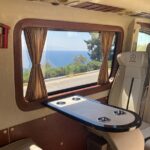
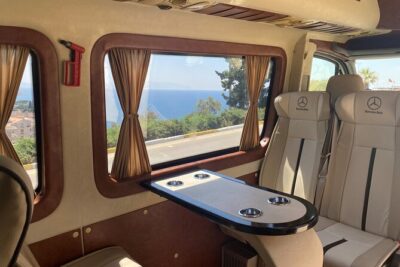
If you’re on a cruise, this is the kind of excursion that helps you avoid the usual time-stress. You get a licensed English-speaking guide, pickup and drop-off, and a brand-new A/C Mercedes Vito with a private driver, plus a local lunch. Expect about 6 to 8 hours, and bring moderate fitness for hills, uneven stone, and crowd movement.
In This Review
- Key Highlights You’ll Actually Feel
- How a Private Ephesus Day Works From Kusadasi
- Pickup, Timing, and the Real Meaning of Skip-the-Line
- House of the Virgin Mary, Bulbul Mountain Quiet Time
- Ephesus Ancient City, the Main Stage of the Day
- State Agora: Not Shopping, More Civic Business
- The Odeion, Small Theatre with Two Jobs
- Temple of Hadrian and Temple of Domitian on Curetes Street
- Hercules Gate and the Street That Got Narrower
- Ephesus Terrace Houses, Roman Daily Life Above the City
- Library of Celsus, a Monumental Tomb That Held Scrolls
- Great Theatre of Ephesus, 25,000 Seats of Power
- Basilica of St John, Last Years and a Later Church
- Temple of Artemis Ruins, Seven Wonders With Marble Secrets
- Okuz Mehmet Pasa Kervansaray, Ottoman Trade Between Ruins
- Kusadasi Bazaar Hour, Buy Small, Think Local
- Lunch, Carpet School Culture, and How to Get More Than One Bite
- Price and Value Check for 75 Per Person
- Who This Tour Fits Best, and Who Might Skip Some Stops
- Should You Book This Tailor-Made Ephesus Tour?
- FAQ
- What is included in the tour price?
- Are entrance fees to Ephesus and other sites included?
- How long is the tour?
- Is this a private tour?
- Do you offer pickup for cruise passengers?
- Do you offer pickup from Kusadasi hotels?
- If I am on a cruise, what information do I need to provide?
- Is the tour physically demanding?
- Is lunch included, and are drinks included?
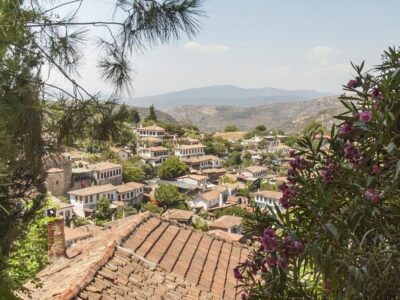
- Can I add a visit to Siringe Village?
- Is free cancellation available?
Key Highlights You’ll Actually Feel
Skip-the-line help** at major sites, so you spend more time looking, less time waiting.
Virgin Mary House visit with the quiet “away from crowds” feeling up on Bulbul Mountain (bring good shoes).
A focused Ephesus route that hits the theatre, Celsus Library, Roman temples, gates, and houses without turning into a long scavenger hunt.
Lunch with local culture (often tied to a carpet weaving setting, sometimes with a short weaving or silk-making demo).
Bazar time in Kusadasi where you can browse without the pressure of squeezing shops between ruins.
Other Ephesus visits, with and without the House of Mary
- FOR CRUISERS: Skip The Lines PRIVATE EPHESUS TOUR &On Time Return★ 5.0 · 8,527 reviews
- Top Choice For Cruisers: Ephesus, Mary’s House WITH TICKETS+LUNCH★ 5.0 · 7,233 reviews
- PRIVATE EPHESUS TOUR FOR CRUISERS: On-time Return and Skip-Line★ 5.0 · 5,807 reviews
- PRIVATE NO HIDDEN FEES Ephesus, Mary’s House Guided Tour /GRP OPT★ 5.0 · 2,455 reviews
How a Private Ephesus Day Works From Kusadasi
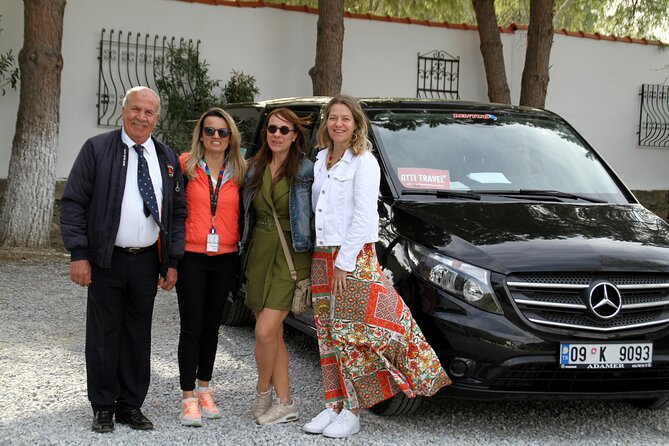
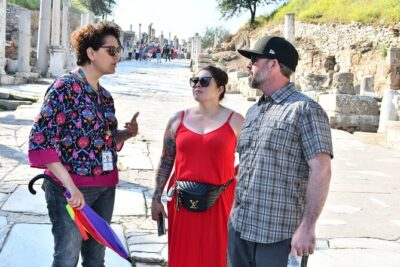
This is a true private tour, meaning it’s just your group in the Mercedes Vito with your driver and guide. That matters because the Ephesus area is built for pedestrians, not tours that herd people. Your guide can slow down for photos, add a quick explanation when something clicks, or shorten a stop if your legs are done.
The day is structured into short, strong blocks. You’ll move from a spiritual hillside stop to the archaeology of Ephesus, then loop through Roman civic buildings, temples, and “day-in-the-life” spaces like the Terrace Houses. Lunch comes in the middle, and then you wrap with more icons and a relaxed hour in the Kusadasi bazaar.
The “tailor-made” part is practical, not marketing. Guides here seem to ask what you want first, then time it so you don’t end up staring at ruins while you wished you had skipped something else. If you’re the type who likes details, you’ll get them. If you’re the type who wants big views and quick orientation, you’ll get that too.
Pickup, Timing, and the Real Meaning of Skip-the-Line
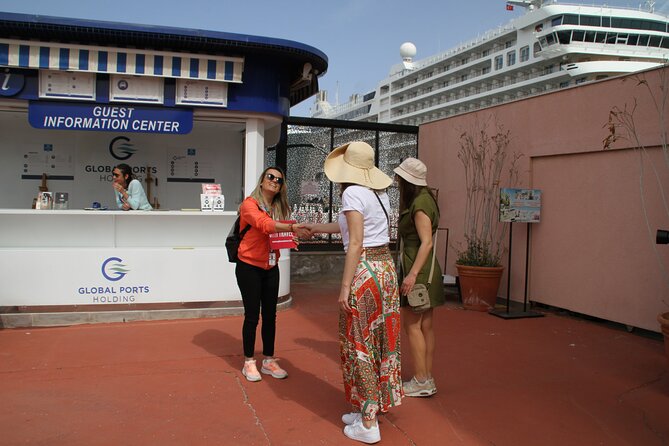
Pickup is handled for cruise passengers and land-based travelers. For cruise guests, you meet at the exit gate of the immigration terminal at the Kusadasi cruise port with an Otti Travel sign. If you’re staying in Kusadasi, you meet at your hotel reception. The tour also offers pickup for Izmir Airport (ADB) at the exit gate of the domestic terminal.
Here’s the value of the skip-the-line promise. At major sites, waiting can eat your best hours. Even when entrance fees are separate, handling tickets and entry flow can save time. The result is you get to start sightseeing sooner and spend more of your day walking where the story is.
One more timing note: this is a 6 to 8 hour day. That’s long enough to cover the essentials, but it’s not an all-day marathon that burns you out by lunchtime. Still, you’ll want to plan for heat, sun, and uneven ground.
House of the Virgin Mary, Bulbul Mountain Quiet Time
The House of the Virgin Mary sits up on Bulbul Mountain, about 9 km ahead of Ephesus. It’s not an open-plaza ruin. It’s a stone structure tucked into greenery, with an atmosphere that feels intentionally calm. The house is described as Roman in style, made entirely of stone, and later associated with a church complex built in the 4th century.
Plan for about 45 minutes. This stop is also the one where physical comfort matters most. There are hills involved getting up and down. If you have hip or mobility issues, choose your footwear carefully, and ask your guide about the best route and pacing. In the tour experience, guides have shown flexibility here, including helping adjust how people move so the visit is still enjoyable.
Admission for this stop is not included, listed at €18 per person. If you’re on a tight budget, it’s one of the big “add-on” costs. But if you care about Christian sites and atmosphere, this is often the moment that feels different from the Roman and Greek stones.
Ephesus Ancient City, the Main Stage of the Day
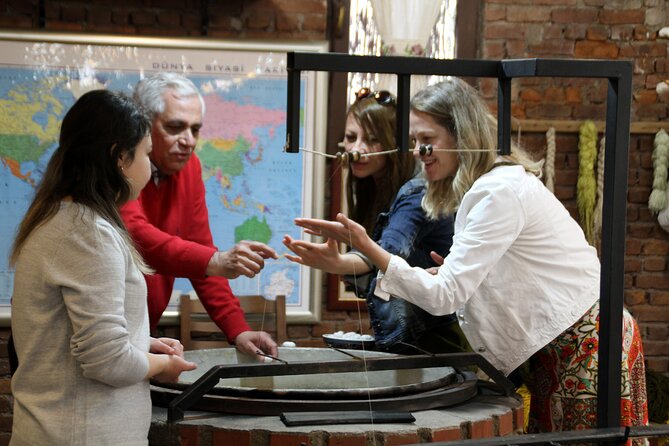
Ephesus is one of those places where you immediately understand why empires fought over it. The ancient city grew through a mix of Greek and Roman eras, and it’s tied to major landmarks like the Artemesium, the Library of Celsus, and the medical school tradition you often hear about in the area.
Your core time here is about 1 hour 30 minutes, and your guide keeps the walk meaningful rather than exhaustive. What I like about this approach is that you don’t just see famous facades, you get connected explanations in the right order. Ephesus can feel like a puzzle box if you only stop for photos.
A practical tip: expect slippery patches on marble pavers and uneven paths. Your guide should pace you and point out footing hazards. Bring shoes with grip, not sandals. It’s a small thing, but it keeps the day comfortable and safer.
Entrance for the Ancient City is not included and is listed at €40 per person. That’s a large chunk of the total day, so the skip-the-line help plus a smart route becomes even more important.
- For Ship Guests:BEST SELLER EPHESUS PRIVATE TOUR & On Time Return
★ 5.0 · 2,029 reviews - ALL INCLUDED: Ephesus Ruins, Mary’s House Tour incl ENTRY TICKETS
★ 5.0 · 1,670 reviews - Ephesus Temple of Artemis and House of Mary Private Half Day Tour
★ 5.0 · 1,573 reviews - PRIVATE TOUR FOR CRUISERS: Mary’s House (Meryemana) and Ephesus
★ 5.0 · 1,349 reviews - Top-Rated: Ephesus & Artemis Tour for Cruisers WITH ENTRY TICKETS
★ 5.0 · 1,184 reviews
State Agora: Not Shopping, More Civic Business
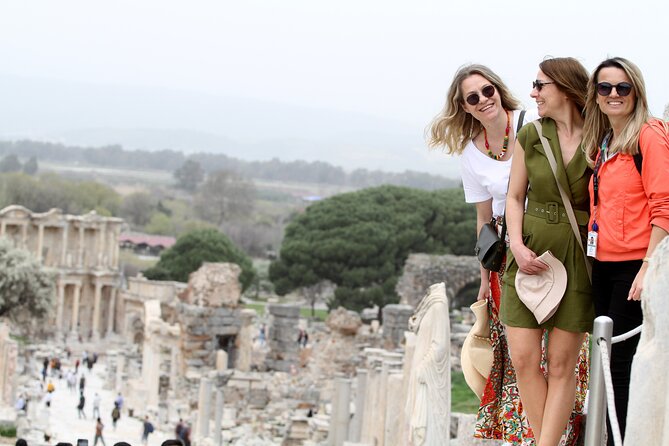
The State Agora sits on the southern part of the Basilica area. This one is interesting because it’s described as a meeting place for governmental discussions, not typical marketplace commerce. You spend about 15 minutes here.
During excavations, graves from earlier periods were found in the northeast corner, along with a stone-paved road and an archaic terra cotta sarcophagus. There’s also a water reservoir at the Agora corner, fed by the Pollio Aqueduct, which has remains visible several kilometers away.
This stop is a good “brain break” between bigger monuments. It’s also where you start to see how Ephesus worked as a functioning civic machine, not just a museum.
The Odeion, Small Theatre with Two Jobs
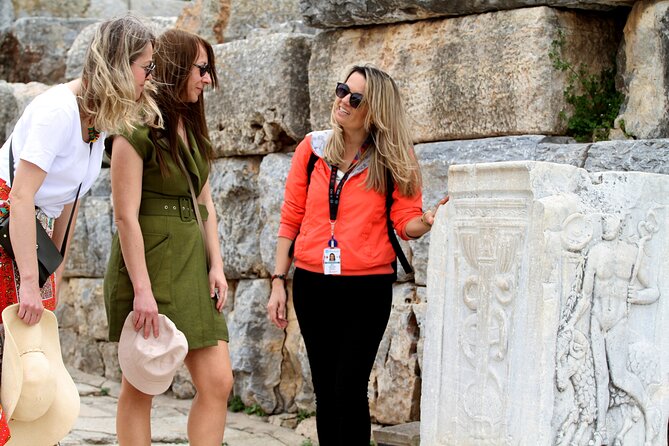
The Odeion is a smaller, theatre-shaped building that had a double function. It could serve as a Bouleuterion for meetings of the Senate and also act as an odeum for performances. Your time here is about 15 minutes.
In the 2nd century A.D, it was built by Publius Vedius Antonius and his wife Flavia Paiana, with a capacity described around 1500 spectators. The stage building is two storeyed, columns are noted, and the wooden roof enclosure is part of the original concept.
If you’re thinking, Wait, why are there so many theatres in one city? This is a clue. Roman Ephesus used performance spaces for real governance too. You’ll feel the city is more political and social than it first appears.
Temple of Hadrian and Temple of Domitian on Curetes Street
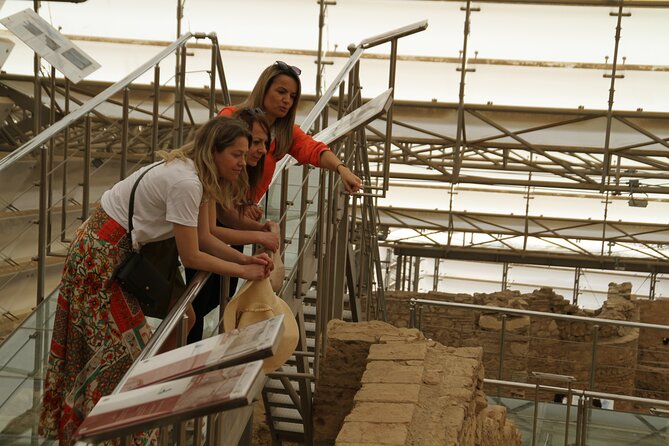
This is where you start reading Ephesus like an imperial map.
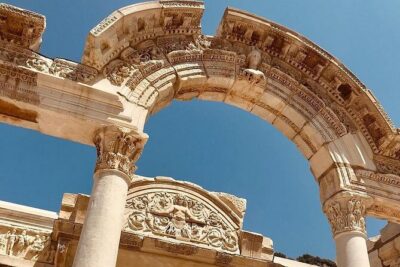
Temple of Hadrian is one of the best-preserved structures on Curetes Street, built before 138 A.D and dedicated to Emperor Hadrian, who visited from Athens in 128 A.D. The facade is described with Corinthian columns and a curved arch relief of Tyche, goddess of victory. It’s quick, around 10 minutes.
Temple of Domitian is dedicated to an emperor and sits on a high terrace. It’s described as the first structure in Ephesus known to be dedicated to an emperor. The terrace is set on vaulted foundations, and stairs are still visible. You’ll likely spend about 15 minutes here.
Why I like pairing them: they show you different kinds of Roman power. One is elegant and decorative, the other is a big statement about imperial permission and civic honor. If you enjoy the “who had the authority here” side of history, these stops are satisfying.
Hercules Gate and the Street That Got Narrower
Near the end of Curetes Street, you reach Hercules Gate. The name comes from a relief of Hercules on the gate. The gate itself was moved in the 4th century A.D, while the relief dates to the 2nd century A.D.
Only the column sides remain today. The rest isn’t found. The relief of flying Nike in Domitian Square is thought to be part of the gate as well. This stop is short, around a few minutes, but it’s a fun one because it hints at how the city changed. The street narrowed to prevent vehicles and become more pedestrian over time.
Ephesus Terrace Houses, Roman Daily Life Above the City
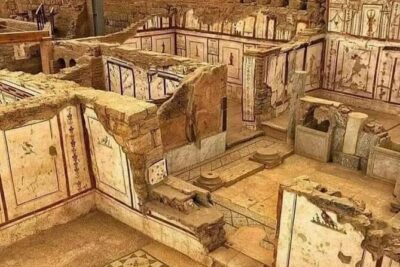
Across from the Hadrian Temple are the Terrace Houses, also called the houses of wealthy Romans. This is the “people” stop. Instead of only monuments, you get spaces that suggest family life in the Roman period.
There are six residential units on three terraces, and the timeline described is long, with the oldest building dating to 1st century B.C, continuing as residences until the 7th century A.D. The houses have protective roofing now, and mosaics plus frescos have been consolidated. Two houses are opened to the public as a museum.
You’ll spend about 30 minutes. Admission for Terrace Houses is not included, listed at €15 per person. This cost can be worth it if you want to understand what luxury looked like, beyond column worship and big theatres.
Library of Celsus, a Monumental Tomb That Held Scrolls
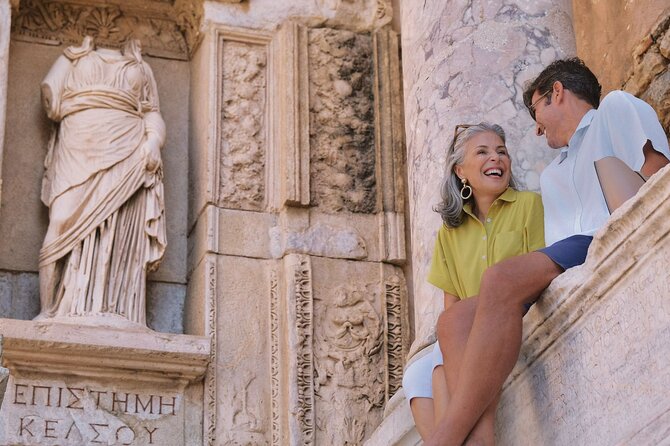
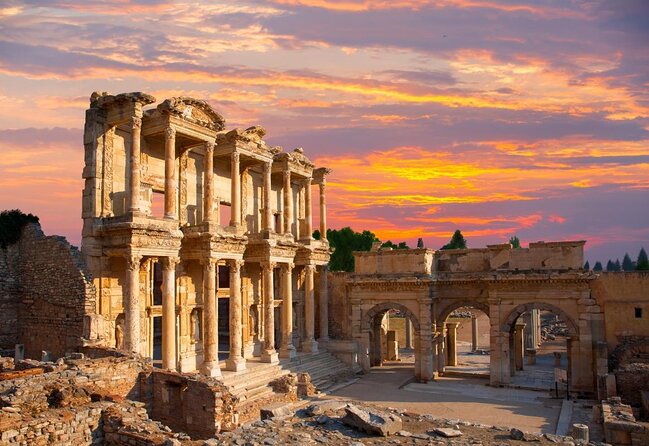
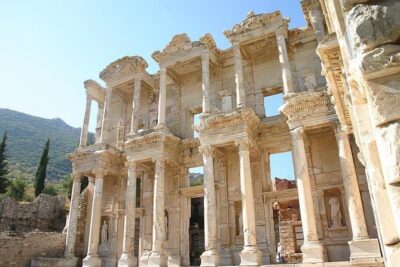
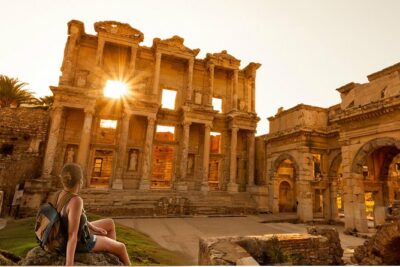
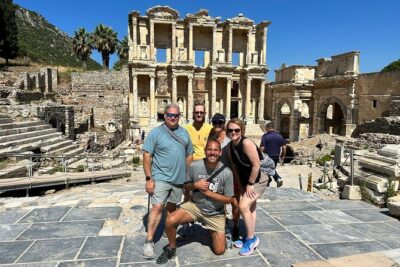
Celsus Library is often the highlight for people who like architecture. The structure was built in 117 A.D and is described as a monumental tomb for Gaius Julius Celsus Polemaeanus, with his grave beneath the ground floor. There’s also a statue of Athena linked to wisdom.
The library design includes niches on walls where scrolls were stored, plus double walls intended to protect books from temperature and humidity extremes. Capacity is described as more than 12,000 scrolls, and it’s called the third richest library in ancient times after Alexandria and Pergamum.
You get about 15 minutes. It’s short, but if you stand back at the front and take in the layers, it’s easier to appreciate why the facade is still famous. Admission is not included for this site as a separate line item because it’s part of the broader Ephesus Ancient City ticket you pay separately.
Great Theatre of Ephesus, 25,000 Seats of Power
Ephesus Great Theatre is described as the most magnificent structure in the city. It started in the Hellenistic period, around the 3rd century B.C, then expanded during Roman times into the style you see today.
The theatre is described as the largest in Anatolia, with a capacity around 25,000 seats. The cavea has 66 rows, divided by walkways into three horizontal sections. There’s mention of an Emperor’s Box and marble pieces found during restoration work.
This is not only entertainment space. The theatre was used for concerts, plays, religious and philosophical discussions, political gatherings, and gladiator and animal fights.
Your time is about 15 minutes. If you can, arrive at a spot where you can look up and imagine voices traveling. It makes the scale feel real. Also, remember your footing again. The stone areas can be slick.
Basilica of St John, Last Years and a Later Church
The Basilica of St John is tied to tradition that St John spent his last years in the region around Ephesus and was buried on the southern slope of Ayosolug Hill. The original chapel is described as built three centuries later over his grave in the 4th century. Then it changed into a basilica under Emperor Justinian between 527 and 565 A.D.
Your visit is about 30 minutes. Entrance is not included and listed at €6 per person.
If you care about Christian history, your guide can connect the early Christian persecution context mentioned for the region to why these later religious sites became important. This stop often lands well for people who want more than purely ancient Greek and Roman civic life.
Temple of Artemis Ruins, Seven Wonders With Marble Secrets
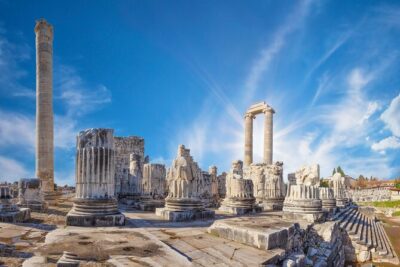
The Temple of Artemis is known as one of the Seven Wonders of the ancient world. The area where it stood was described as turning into a swamp over time, so today you mainly see ruins of the foundations.
You’ll spend about 25 minutes, and admission is listed as free. While the columns are mostly gone, the ruins still communicate what once made this place a marble icon. The tour also connects the most beautiful remaining pieces to the British Museum, which helps you understand why fragments traveled far from Ephesus.
It’s one of those stops where you benefit from a guide’s context. Without it, you might just see a foundation field. With context, you see the plan and scale.
Okuz Mehmet Pasa Kervansaray, Ottoman Trade Between Ruins
Okuz Mehmet Pasa Kervansaray is an Ottoman caravanserai built between 1615 and 1618 by Öküz Mehmed Pasha, described as governor of Ottoman Egypt and Grand Vizier. It was built like a fortress and used as a customshouse.
Renovation is described as starting in 1954 and continuing until 1966, with a renovation cost mentioned as ₺2.1 million, about US$0.21 million, not counting shanty nationalization costs on the three sides.
Your time here is about 10 minutes. Admission is free. I like this stop because it gives you a breather after ancient stone. You shift from antiquity to Ottoman-era travel and trade logic, the kind of history that explains why this region kept changing hands.
Kusadasi Bazaar Hour, Buy Small, Think Local
The day ends with about 1 hour of free time in the Kusadasi bazaar. It’s a big market area with shops selling everything from Turkish goods to leather products, sweets, small knick-knacks, and also cheaper souvenir items.
Here’s how I’d play it. Set a goal before you arrive, like buying a few sweets or one practical item, rather than drifting into the long aisle loop. If you want textiles, ask questions about materials and weaving, since the region’s craft culture shows up elsewhere in the day too.
This is not “ruins time.” It’s a chance to reset, grab water, and pick something tangible from your day.
Lunch, Carpet School Culture, and How to Get More Than One Bite
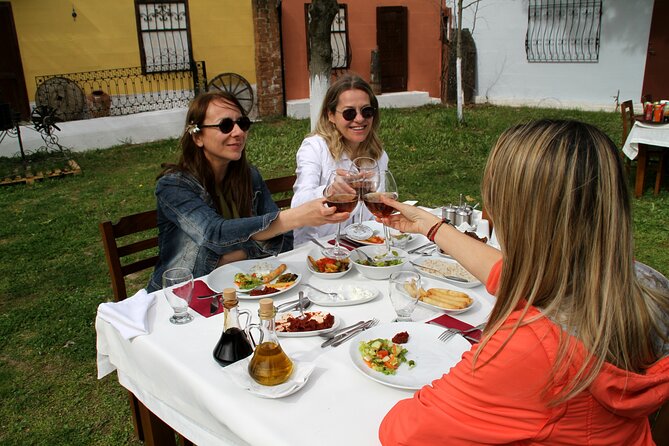
Lunch is included, and drinks are not. The food is described as local, and you may get a mezze-style meal depending on the lunch spot arranged for your group.
Several guides’ experiences also link lunch to a carpet weaving school setting, and you might see a short demonstration that explains how silk is produced, including a process involving mulberry leaves and cocoons. If you’re allergic to hard-sell shopping, keep your expectations grounded. Still, the practical value is that you get context for what you see, and you can decide calmly if you want to buy.
If you do buy, don’t rush. Ask what’s machine-made versus handwork. Take your time, and compare pieces you like, not just what a salesperson highlights first.
Price and Value Check for 75 Per Person
At $75 per person, the tour price gives you the guide, private transport in a brand-new A/C Mercedes Vito with a driver, pickup and drop-off for cruise and land guests, a local lunch, and skip-the-line help.
But the big thing to understand is what’s not included. Entrance fees listed include:
- Ephesus Ancient City €40 per person
- House of the Virgin Mary €18 per person
- Terrace Houses €15 per person
- Basilica of St John €6 per person
Temple of Artemis is free, and Okuz Mehmet Pasa Kervansaray is free.
So the real decision is about fit. If you want the essentials plus religious sites like the Virgin Mary House and St John Basilica, you’re accepting those separate entrance fees. In return, you get a guided flow that helps you connect the places fast, and you avoid spending your day lost in logistics or stuck in entry lines.
Also, because the tour is private, you are not paying for large group constraints. If you’re traveling as a couple or small family, that private structure is often where the value shows up most.
Who This Tour Fits Best, and Who Might Skip Some Stops
This tour suits people who want a guided sweep of Ephesus without feeling rushed. It’s also a good match if Christian history matters to you, since the day includes both the House of the Virgin Mary and the Basilica of St John.
It’s a less ideal fit if you have very limited ability for hills and uneven terrain. The Virgin Mary House involves climbing on Bulbul Mountain, and several areas in Ephesus include stone steps and slick marble patches.
It can also be a good fit if you hate shopping pressure. The lunch and carpet setting may include demonstrations, but the best part is you still control your pace and your stop priorities with a guide who can accommodate requests.
Should You Book This Tailor-Made Ephesus Tour?
Yes, if you want an efficient, guided Ephesus day that includes both the Roman highlights and Christian sites, and you like having someone local plan the rhythm. The private vehicle, licensed English-speaking guide, skip-the-line support, and included lunch are a strong bundle.
I’d book with a clear plan on entrance fees before you commit, because those extras add up fast once you add Ephesus, the Virgin Mary House, Terrace Houses, and St John. If you’re budget-focused, decide which of those you truly want and consider skipping optional add-ons.
If you tell me your travel style, like ruins-only versus religious sites too, cruise or land stay, and how many in your group, I can help you decide whether the included route feels like your kind of day.
FAQ
What is included in the tour price?
You get a professional licensed English speaking tour guide, pickup and drop-off for cruise guests, guaranteed skip-the-line tickets, and transportation in a brand new A/C luxury Mercedes Vito with a private driver. Lunch is also included. Mobile ticket is offered.
Are entrance fees to Ephesus and other sites included?
No. Admission fees are listed separately for Ephesus Ancient City, the House of the Virgin Mary, Terrace Houses, and the Basilica of St John. Temple of Artemis and Okuz Mehmet Pasa Kervansaray are listed as free.
How long is the tour?
The duration is approximately 6 to 8 hours.
Is this a private tour?
Yes. It is a private tour/activity, so only your group participates.
Do you offer pickup for cruise passengers?
Yes. For cruise passengers, the meeting point is at the exit gate of the immigration terminal of the Kusadasi cruise port, with a board showing the OTTI Travel sign.
Do you offer pickup from Kusadasi hotels?
Yes. For pick up from Kusadasi hotels, you meet the guest by the hotel reception.
If I am on a cruise, what information do I need to provide?
At the time of booking, cruise passengers must provide ship name, docking time, disembarkation time, and re-boarding time.
Is the tour physically demanding?
The tour notes a moderate physical fitness level is required. The route includes sites with hills and walking on stone areas.
Is lunch included, and are drinks included?
Lunch is included. Alcoholic beverages and drinks at lunch are not included.
Can I add a visit to Siringe Village?
Yes. Visiting Siringe Village is listed as not included, at $50 per booking.
Is free cancellation available?
Yes. You can cancel up to 24 hours in advance for a full refund. If you cancel less than 24 hours before the start time, the amount paid is not refunded.
Ephesus, Other Ways to See It

Recently reviewed in Kusadasi
The rest of Ephesus and the House of the Virgin Mary.
 ★ 5.0FOR CRUISERS: Skip The Lines PRIVATE EPHESUS TOUR &On Time ReturnFrom $398,527 reviews
 ★ 5.0PRIVATE NO HIDDEN FEES Ephesus, Mary’s House Guided Tour /GRP OPTFrom $992,455 reviews
 ★ 5.0For Ship Guests:BEST SELLER EPHESUS PRIVATE TOUR & On Time ReturnFrom $392,029 reviews
 ★ 5.0ALL INCLUDED: Ephesus Ruins, Mary’s House Tour incl ENTRY TICKETSFrom $591,670 reviews
 ★ 5.0Ephesus Temple of Artemis and House of Mary Private Half Day TourFrom $151,573 reviews
 ★ 5.0PRIVATE TOUR FOR CRUISERS: Mary’s House (Meryemana) and EphesusFrom $291,349 reviews
 ★ 5.0Top-Rated: Ephesus & Artemis Tour for Cruisers WITH ENTRY TICKETSFrom $201,184 reviews
 ★ 4.8Ephesus: Small Group Tour for Cruise PassengersFrom $291,100 reviews