

REVIEW · AUDIO TOURS
Istanbul Archaeological Museums Entry Ticket & Audio Guide
Ancient treasures, ready at your pace. The Istanbul Archaeological Museums pair a skip-the-line QR ticket with a 25-language audio guide, so you can move through galleries, tombs, and relics without waiting around.
Two highlights I really like are the chance to understand major icons such as the Statue of Hermes and the Aphrodite, and the freedom to stop, rewind, and keep going at your own speed. One key drawback to plan for: even with the QR ticket, security checks and potential entrance lines are still mandatory, and a bit of renovation or closed access can shorten what you can see.
In This Review
- Key things to know before you go
- How the QR ticket and security process really works
- The audio guide in 25 languages, and how to use it well
- Main museum icons: Hermes, Aphrodite, and the stories behind big statues
- Tombs and sarcophagi: what to look for in the Crying Women and Lykia displays
- Old Eastern Works Museum and the Enameled Kiosk Museum from 1472
- Price and logistics: does $25 feel like value?
- A realistic plan for your time in the museums
- Getting there from Gulhane station, T1 tram route
- Should you book this QR ticket and audio guide?
- FAQ
- How long is the Istanbul Archaeological Museums entry ticket valid for?
- What is included with this ticket?
- Is this a guided tour?
- Do I need internet to use the QR tickets?
- Where should I go to get there?
- Will security lines be skipped with the digital ticket?
- Will I need to bring a passport?
- What is the cancellation policy?
Key things to know before you go

- A QR ticket helps you enter faster, but it does not skip security lines.
- Audio guide in 25 languages lets you match exhibits to stories, including major statues and tomb reliefs.
- Your QR codes appear near the entrance, so keep your phone ready with internet.
- Passports may be requested for age validation, even for children.
- Not a guided tour: you get entry plus audio, not a person walking you through.
- You can cover a lot, but you might not need all day depending on closures and your pace.
Undecided? These Istanbul tours came up most often in the review pile.
- Istanbul: Bosphorus Dinner Cruise & Show with Private Table★ 4.8 · 44,561 reviews
- Istanbul: Daytime or Sunset Sightseeing Cruise & Audio Guide★ 4.8 · 14,430 reviews
- Istanbul: Bosphorus Dinner Cruise with Turkish Night Show★ 4.8 · 10,127 reviews
- Best of Istanbul 1, 2 or 3-Day Private Guided Istanbul Tour★ 5.0 · 8,922 reviews
How the QR ticket and security process really works

This experience is built around self-entry. You are given a QR entry ticket plus an audio guide link, and then you walk in on your own. That sounds simple, but the details matter, especially in big museum entrances where queues form.
Here is what to expect with the QR codes:
- You will receive both entry ticket QR codes and the audio guide link via separate emails from Istanbul Tourist Pass.
- You cannot skip the security line, even if your ticket is digital.
- The QR tickets are only shown when you are near the museum entrance, not hours earlier.
- You need an internet connection on your smartphone to access and pull up your QR codes.
If you want this to feel smooth, I’d treat the QR as a last-minute setup task. Charge your phone, keep your battery saver off if possible, and have the email ready so you are not searching under stress while you are standing near the entrance.
Also remember the museum may ask for valid passports to validate age. That includes children, not just adults. If you have a family traveling, this is one of those rules that can slow you down unless you plan ahead.
One more practical note: the ticket is described as skip-the-line entry, but the provider also warns there can still be a line at the entrance. So your goal is faster entry into the museum flow, not a guaranteed empty door.
The audio guide in 25 languages, and how to use it well
The standout value here is the audio guide. Not just because it exists, but because it is designed to work with the museum as you wander. It is available in 25 languages, including English, French, German, Italian, Spanish, Portuguese, Russian, Turkish, Arabic, Persian, Urdu, Hindi, Japanese, Korean, Chinese, and more.
What I like about this setup is that it is not all-or-nothing. You do not have to sit through one long “tour voice.” You can:
- Listen to a stop for a minute, move on, then come back.
- Pause for photos without losing your place.
- Spend more time when a scene or object catches your eye.
A couple of real-world audio details are worth knowing. The audio guide may not always be perfectly numbered end-to-end, so if you notice the track order feels odd, keep calm and follow the exhibit order on site. The good news is that some languages are reported as especially clear in pronunciation. If you are relying on Japanese audio, for example, the track quality has been described as easy to understand, and the language accuracy can help you follow even if you are not an art historian.
One more smart strategy: the museum experience can work well with both audio and quick text scanning. If you see labels, you can read them and then use the audio to fill in what you missed. If you do not speak the label language, you can use translation tools for the text while you listen to the audio narration.
In short, this is a good option if you like to travel like a curious person, not like a passenger in a bus schedule.
Main museum icons: Hermes, Aphrodite, and the stories behind big statues

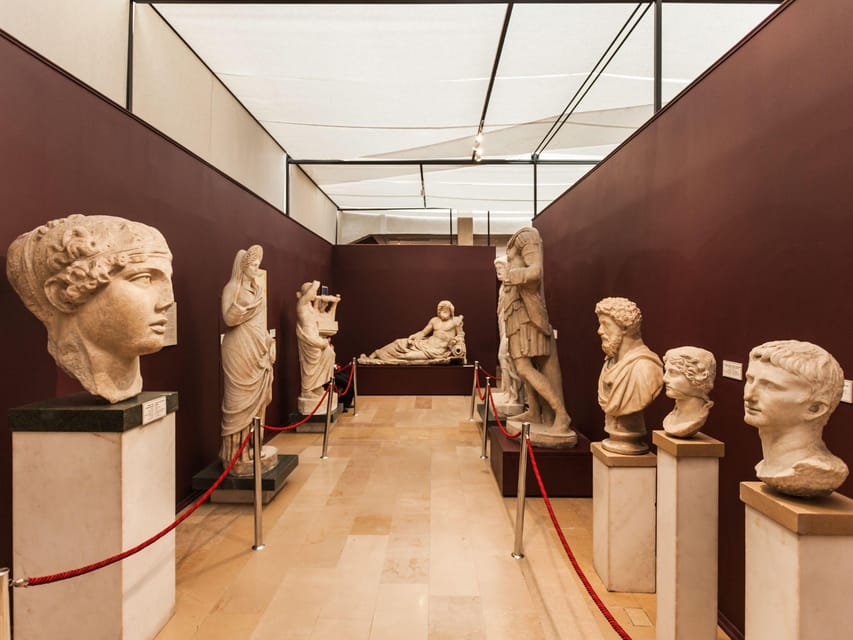
Inside, you are looking at artifacts from several civilizations, including Greece, Egypt, and Mesopotamia. This matters because the Archaeological Museums are not just about one culture. You get a sense of how different worlds valued gods, rituals, power, and daily life.
Two icons listed for this ticket experience are:
- Statue of Hermes
- Aphrodite
When you see a statue like Hermes, I’d focus on how the figure is presented. Even without deep context, the posture, craftsmanship, and expression can hint at the role the figure played. Hermes was widely associated with messages and movement, so audio narration often helps you connect the human form to a bigger myth system.
For Aphrodite, the same idea applies. You can look at the statue as art, but it also becomes a window into how ancient societies pictured beauty, love, and divine presence. The audio guide format is helpful here because you can match what you are seeing to a story, rather than treating the museum like a checklist of names.
The museum also includes everyday-object details, not just famous names. That can be more satisfying than you expect. When the audio guide turns to the “small stuff,” you often get better insight into how people lived, not only how empires displayed power.
The potential downside is pacing. If you move too quickly, you might collect impressions but miss the meaning. So I’d plan to spend extra time on the big sculpture stops, then give yourself permission to speed up on areas that feel less relevant to you.
Tombs and sarcophagi: what to look for in the Crying Women and Lykia displays
The ticket highlights include several dramatic funerary works:
- Crying Women Tomb
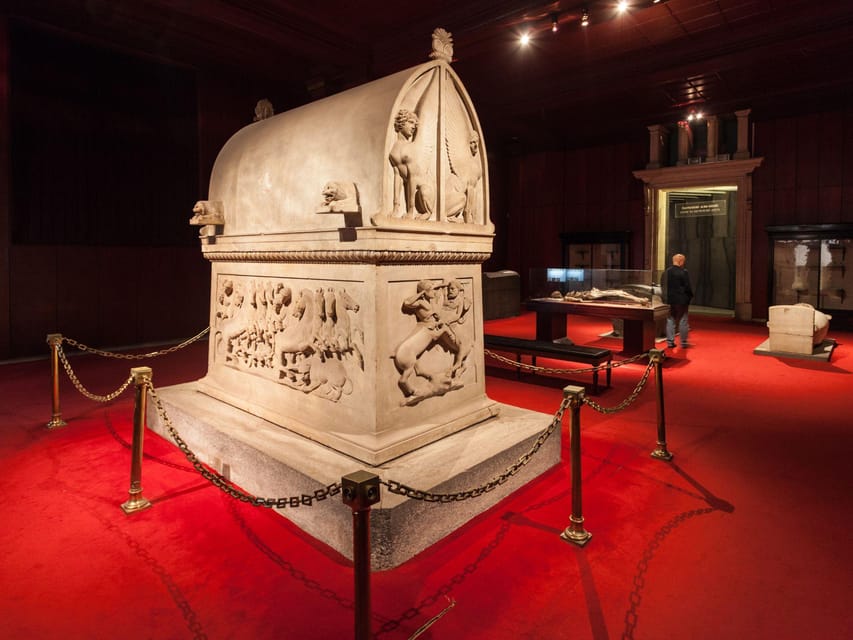
- Lykia Tomb
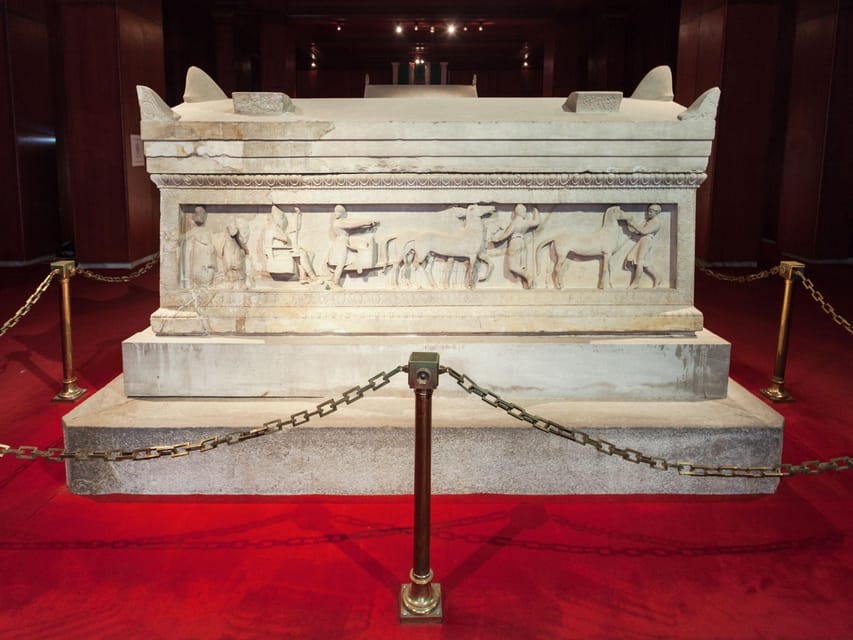
- Alexander Sarcophagus
Tombs and sarcophagi can feel heavy and repetitive if you do not know what you are looking for. The audio guide helps because funerary art is loaded with symbolism. It is not just decoration. It is communication about identity, status, belief, and memory.
For the Crying Women Tomb, look at the figures and the emotional expressions. Tomb art often uses gestures and faces to tell you how grief should be understood, not just that it exists. Let the audio story lead you through it. If you only glance at the scenes, you might miss the way the narrative repeats across faces or folds.
With the Lykia Tomb, focus on the carving style and the structure of the reliefs. Lykia-linked displays often reward careful viewing because the workmanship can be intricate. Audio narration can help you connect those details to cultural choices, like what mattered enough to carve rather than paint.
Then there is the Alexander Sarcophagus, one of the most talked-about pieces in this museum ecosystem. Even if you know the name, the value is in the connections the audio guide makes between the artwork and the historical world that produced it. When audio points out what a specific scene is doing, the sarcophagus shifts from “impressive object” into “story in stone.”
Practical tip: give yourself enough time here to slow down. If you are visiting on a tight schedule, funerary art is one of the first areas I’d prioritize, because the payoff for attention is high.
- Istanbul: Daytime or Sunset Sightseeing Cruise & Audio Guide
★ 4.8 · 14,430 reviews - Best of Istanbul 1, 2 or 3-Day Private Guided Istanbul Tour
★ 5.0 · 8,922 reviews - Istanbul: Basilica Cistern Fast-Track Entry and Audio Guide
★ 4.6 · 7,521 reviews - Istanbul: Hagia Sophia Skip-the-Line Ticket & Museum Option
★ 3.7 · 4,958 reviews - Istanbul: Hodjapasha Whirling Dervishes Show & Exhibition
★ 4.4 · 4,790 reviews
Old Eastern Works Museum and the Enameled Kiosk Museum from 1472
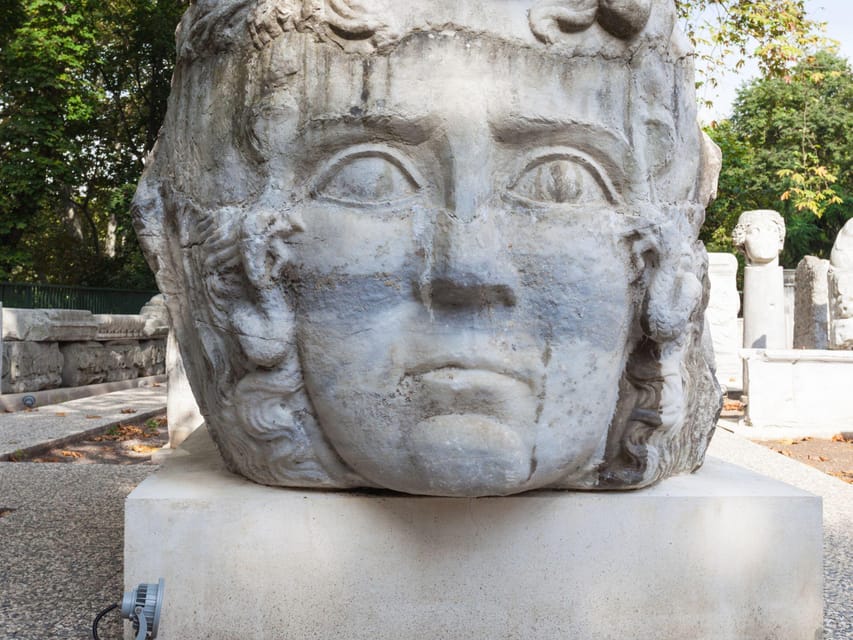
Beyond the big-name statues and tombs, this ticket points you to areas that show how the museum collection stretches across geography and time.
Two stops that stand out in the description are:
- Old Eastern Works Museum
- Enameled Kiosk Museum (established in 1472 by Fatih Sultan Mehmet)
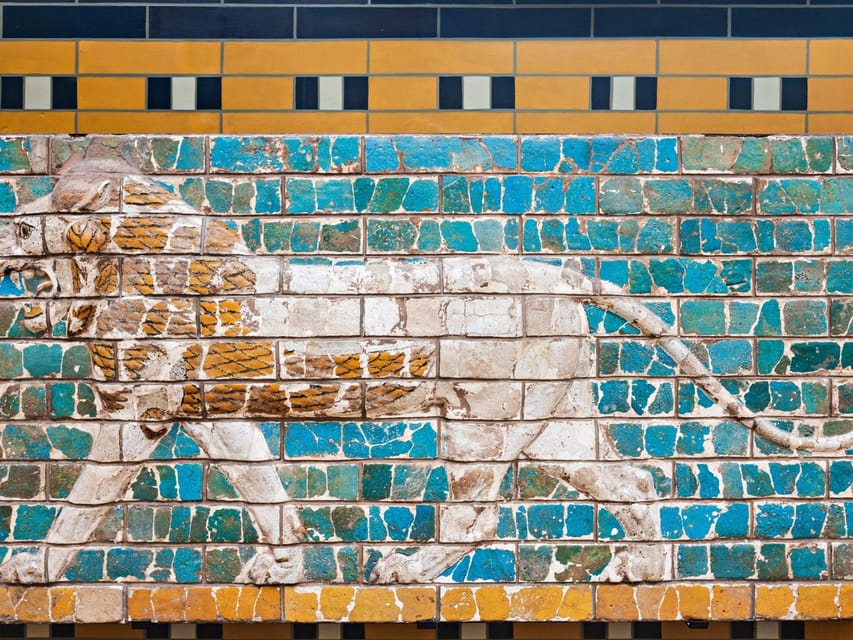
The Old Eastern Works Museum is described as housing artifacts from regions like Anatolia, Mesopotamia, Egypt, and Arabia. That cross-regional mix can be a major reason to visit, because it helps you see patterns in materials, motifs, and craftsmanship. I like collections like this when I want to understand the “in between.” Not just the headline empire, but the cultural exchange that happens around it.
The Enameled Kiosk Museum adds a different flavor. It is tied to early Ottoman art and the historical figure of Fatih Sultan Mehmet. If you are used to thinking of archaeology museums as only ancient, this is the place to notice how later eras preserved, interpreted, and displayed older influences.
What you might miss if you rush: the shift in style. Ancient stone and funerary reliefs can feel like one world. Ottoman enameled decoration can feel like another. If you let the audio guide bridge the change, your understanding of “continuity” improves.
A final practical heads-up: there may be renovation affecting access to parts of the exterior and possibly sections of the complex. If you see barriers, adapt your route and focus on the indoor galleries and the sections still open.
Price and logistics: does $25 feel like value?
At $25 per person for a one-day ticket with audio, the real question is whether you will use both components. If you want quick entry plus interpretation, it can be a smart buy. If you want only a plain ticket and you plan to rely on random phone facts, you might feel the price is higher than the experience.
Here is how the value holds up:
- The ticket includes skip-the-line entry, which can save time during peak hours.
- The ticket includes an audio guide in 25 languages, which can genuinely change how much you get out of each room.
- You are not paying for a human guide, so the cost is focused on entry and the recorded storytelling.
But there are costs you should expect beyond the ticket:
- Transportation fees are not included.
- Wi-Fi access at the museum is not included.
- You need internet on your smartphone to access your QR codes.
Also, value depends on what you actually see. If closures or renovations limit access, the experience may feel shorter. One description notes it will not take you long to get around, which can be good if you prefer a focused museum visit, but it can feel less “full-day” if you were expecting a long marathon.
My take: $25 can be fair value if your goal is to understand what you are seeing. The audio guide is the difference between looking at objects and reading the museum in context.
A realistic plan for your time in the museums
This is a 1-day entry experience. That means you should plan for flexibility, not a rigid schedule. You can do a careful route, but you do not have to do every single room to get satisfaction.
Here is a practical approach that works with the self-entry format:
- Start with the areas tied to the ticket highlights, especially if you care about the statues and tomb works.
- Use the audio guide to decide when to pause. If a room is not clicking, move on.
- Save the more architectural or style-shift areas for when you still have energy.
Also, do not underestimate the impact of the on-site flow. Even with skip-the-line entry, security checks are mandatory, and there may be a line at the entrance. Add a little buffer so you do not feel rushed once inside.
Bathrooms are part of the comfort equation too. One note suggests toilet signage may not be clear, so I’d suggest you check directions on your first loop, rather than waiting until you desperately need it.
Getting there from Gulhane station, T1 tram route
The meeting point guidance is simple and useful:
- Take the T1 Bağcılar to Kabataş tram.
- Get off at Gulhane station.
- Walk about 5 to 10 minutes to the museum.
This is a great plan because it is straightforward and easy to connect with other parts of Sultanahmet and the historic peninsula. Before you go, I’d still confirm the nearest entrance you want to use, because renovation or barriers can shift where lines form and where people funnel.
Should you book this QR ticket and audio guide?
Book it if:
- You want faster entry and you hate ticket lines.
- You enjoy learning through an audio narrative in your own language.
- You like moving at your pace instead of following a group schedule.
- You want the flexibility to spend extra time on the Hermes and Aphrodite type icons, then switch to tombs and sarcophagi when you feel ready.
Skip or rethink it if:
- You are expecting a true guided tour with a person leading you room to room.
- You are going during a time when you strongly dislike any type of security line, since QR does not skip those checks.
- You plan to visit mostly for quick photos and do not think you’ll listen to much audio.
If your style is self-guided curiosity, this ticket is a solid way to experience the Istanbul Archaeological Museums. The audio guide is what turns famous names into meaning, and the QR entry is what keeps the day from wasting time before you even step inside.
FAQ
How long is the Istanbul Archaeological Museums entry ticket valid for?
It is valid for 1 day. You can check availability for the starting times.
What is included with this ticket?
You get an audio guide in 25 languages and a skip-the-line entry ticket for the Archaeological Museums.
Is this a guided tour?
No. This is not a guided tour. You receive an entrance ticket to enter on your own, with the audio guide for context.
Do I need internet to use the QR tickets?
Yes. You need an internet connection on your smartphone to get your QR tickets. The QR codes are shown when you are near the entrance.
Where should I go to get there?
Take the T1 Bağcılar to Kabataş tram and get off at Gulhane station. The museum is an easy 5 to 10 minute walk away.
Will security lines be skipped with the digital ticket?
No. It is not possible to skip security lines. There can be a line at the entrance and it is mandatory for all visitors.
Will I need to bring a passport?
Yes. All persons and children may be asked to present valid passports at the entrance to validate their age.
What is the cancellation policy?
Free cancellation is available up to 24 hours in advance for a full refund.
Recently reviewed in Istanbul






The rest of Audio Tours.
 ★ 4.8Istanbul: Daytime or Sunset Sightseeing Cruise & Audio GuideFrom $814,430 reviews
 ★ 4.6Istanbul: Basilica Cistern Fast-Track Entry and Audio GuideFrom $447,521 reviews
 ★ 4.1Istanbul: Topkapi Palace & Harem Museum Ticket & Audio GuideFrom $613,977 reviews
 ★ 4.6Istanbul: Bosphorus Sightseeing Cruise Tour with Audio GuideFrom $82,694 reviews
 ★ 4.3Istanbul: Hagia Sophia Skip-the-Line Ticket and Audio GuideFrom $352,246 reviews
 ★ 4.4Istanbul: Hagia Sophia Skip-the-Line Ticket with Audio TourFrom $421,767 reviews
 ★ 3.9Istanbul: Bosphorus Cruise w/Audio Guide and Sunset OptionFrom $141,758 reviews
 ★ 4.6Istanbul: Basilica Cistern Skip-the-Line Entry & Audio GuideFrom $711,477 reviews
Also filed under